
White-Faced Capuchin Monkeys in Costa Rica
October 12, 2026 · Caribbean Winds
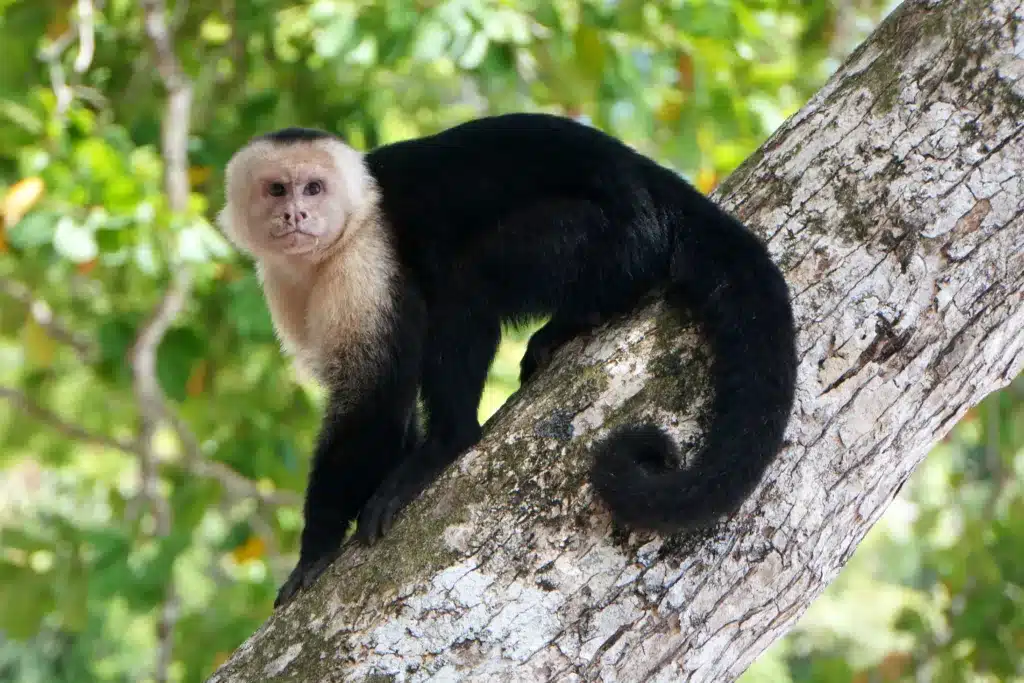
Meet the white-faced capuchin
A pale face, cream-colored shoulders and a black body make the white-faced capuchin one of Costa Rica’s most recognizable monkeys. Locally, you may hear mono carablanca or mono capuchino. A quiet moment watching one search a branch can reveal much more than a quick photograph.
The Costa Rican species is Cebus imitator, often called the Central American or Panamanian white-faced capuchin. Older Costa Rican references use Cebus capucinus or Cebus capucinus imitator, so the names can look different even when a guidebook is describing local white-faced capuchins. The IUCN assessment for Cebus imitator is a useful reference for the modern species name.
A forest monkey with a flexible diet
Capuchins are active by day and spend much of their time in trees, although they also descend to the ground. Their prehensile tail helps them hold and balance among branches. They live in social groups; group size varies, so there is no single number you should expect to see.
They are omnivores, not simply fruit eaters. Their food can include fruit, insects, eggs and small vertebrates. You may notice them checking bark, leaves or other hiding places instead of just picking fruit. Costa Rica’s Área de Conservación Guanacaste species account describes their appearance, habitats and natural diet.
Research on wild capuchins in Santa Rosa documents fruit feeding, invertebrate foraging and seasonal changes in food use. That is a good reason to let a monkey choose its own food: a visitor’s snack is not part of the natural encounter we want to encourage.
Where do capuchins live in Costa Rica?
Their habitats include tropical dry forest, humid forest, secondary forest, riverbank woodland and mangroves. Protecting connected trees and forest patches matters because wildlife needs space to move, feed and shelter.
For visitors staying in La Fortuna, the best approach is to choose a guided nature experience and ask about the habitats on the day’s route. A forested riverbank can offer opportunities to look for monkeys, but no particular species, group size or sighting is guaranteed. Listen to your guide and enjoy whatever the forest reveals.
How to watch capuchins responsibly
SINAC’s visitor guidance specifically warns against feeding wildlife and leaving food-filled bags exposed to white-faced monkeys. Keep these habits throughout your visit:
- Do not feed them, including fruit or food that looks “natural.”
- Keep snacks packed away and close bags securely.
- Watch quietly from the trail or the position selected by your guide.
- Give animals room to move; do not touch, chase or surround them.
- Keep children beside an adult and avoid attempts to pose with a monkey.
- Use your camera’s zoom instead of moving closer.
If an animal comes toward your food, tell the guide and follow their instructions. A curious expression is not an invitation to interact.
Conservation starts with the kind of encounter we choose
The IUCN’s 2021 assessment lists Cebus imitator as Vulnerable. Responsible visits should support habitat protection and allow wild animals to keep their natural behavior.
Our role as visitors is straightforward: leave food out of the encounter, respect forest rules and choose guides who observe without baiting or handling wildlife. An unhurried sighting from a respectful distance is the experience worth taking home.
Plan a wildlife experience near La Fortuna
Explore our Safari Float on the Peñas Blancas River to learn about riverbank habitats with a local guide. Ask our team about participation requirements and current conditions. Wildlife sightings depend on natural activity and are never guaranteed.